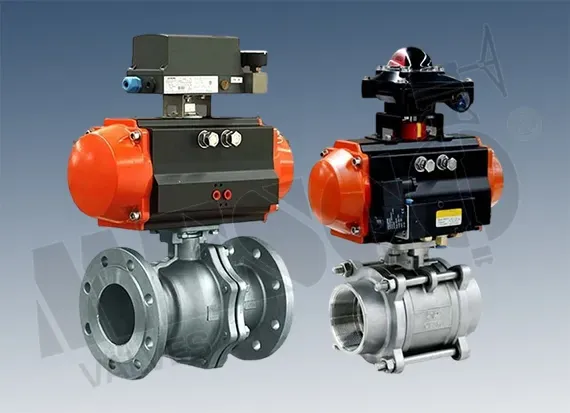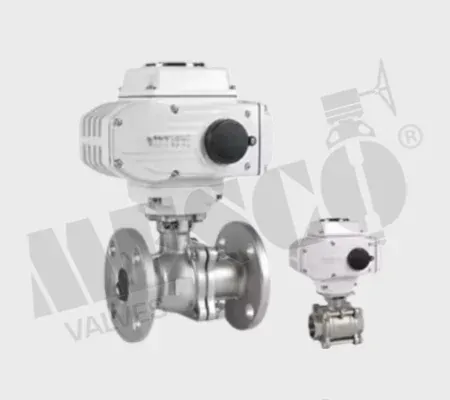
Automating a ball valve means adding an actuator. The two common choices are pneumatic (compressed air) and electric (motorized). Both turn the ball 90°, but they behave differently in operation, failure and cost.
Comparison table
| Factor | Pneumatic | Electric (motorized) |
|---|---|---|
| Power source | Compressed air | Electrical supply |
| Speed | Very fast | Slower, set by gear ratio |
| Fail-safe | Spring return – simple and reliable | Needs battery / spring-return electric models |
| Hazardous areas | Inherently suitable (with suitable solenoid) | Needs flameproof enclosure |
| Cycle frequency | High | Limited by motor duty rating |
| Modulating control | Needs positioner | Built-in options available |
| Infrastructure | Compressor, air lines, FRL | Cabling only |
Choose pneumatic when…
- The plant already has instrument air.
- You need fail-safe action on power or air failure.
- Valves cycle frequently or must act fast.
- The area is hazardous.
See pneumatic actuated ball valves.
Choose electric when…
- No compressed air is available – remote sites, water networks, buildings.
- You need positioning or feedback without extra accessories.
- Cycle frequency is moderate.
What to include in your enquiry
Valve size and class, maximum differential pressure, fail position, air pressure or voltage, control signal, enclosure rating, and accessories (solenoid, limit switches, positioner, manual override).