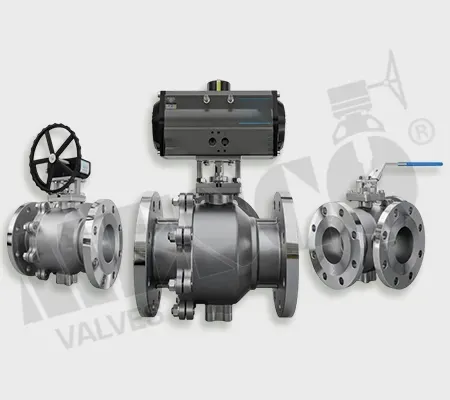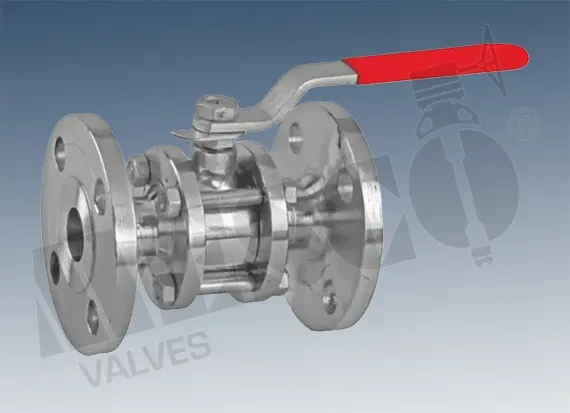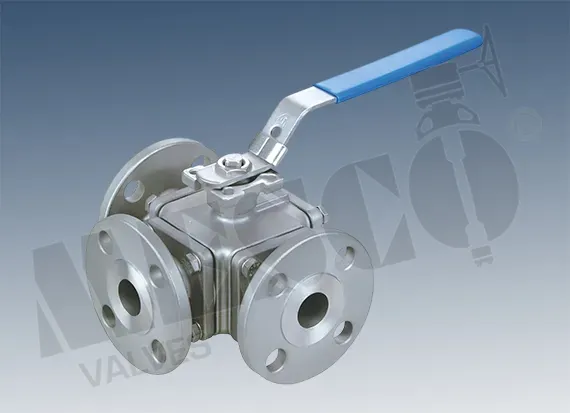
“Ball valve” covers a very wide family of products – from a palm-sized brass valve on an air line to a 24-inch trunnion valve on a pipeline. When buyers send an enquiry for a “2-inch ball valve”, the manufacturer still has to ask a dozen questions. This guide explains the main ways ball valves are classified, so you can include the right details in your specification.
How a ball valve works
Every ball valve has a ball with a hole (bore) through it, held between two seats inside a body. A stem connects the ball to a lever or actuator. Turning the stem 90° aligns the bore with the pipe (open) or turns it across the flow (closed). This quarter-turn action makes ball valves quick to operate and easy to automate, and the seats wiping the ball on every stroke gives tight shut-off.
1. By body construction
- One-piece – body machined from a single block, usually reduced bore and not repairable. Common for mini ball valves.
- Two-piece – body plus end connector; the most common general-purpose design.
- Three-piece – two end caps and a removable centre body; serviceable in-line, ideal for welded lines.
- Top entry – internals accessed from the top; used in critical pipeline service.
2. By bore size
Full bore valves have a bore equal to the pipe ID, giving minimal pressure drop and allowing pigging. Reduced bore valves are one size smaller, lighter and cheaper. See full bore vs reduced bore.
3. By ball support
In a floating ball valve, line pressure pushes the ball against the downstream seat. In a trunnion mounted ball valve, the ball is fixed top and bottom and spring-loaded seats seal against it. Trunnion designs are used for large sizes and high pressures. Read floating vs trunnion.
4. By number of ports
Two-way valves have one inlet and one outlet for on/off service. Three-way ball valves have L-port or T-port balls to divert or mix flow. Four-way designs exist for special applications.
5. By end connection
- Threaded (screwed) – BSP or NPT, small bores.
- Socket weld and butt weld – permanent, leak-free joints in process piping.
- Flanged – ANSI, DIN or BS; bolt-in for larger sizes.
6. By operation
- Manual – lever or gearbox.
- Pneumatic actuated – compressed air, fast and fail-safe.
- Motorized / electric actuated – power and signal only.
Special-purpose ball valves
- PTFE lined – corrosive chemicals.
- Jacketed – media that must stay hot.
- Flush bottom – tank and reactor outlets.
- High pressure – hydraulic and instrument lines.
Putting it together in a specification
A complete specification combines all six: e.g. “2", three-piece, full bore, floating ball, two-way, butt weld ends Sch 40, SS316 body and trim, RPTFE seats, Class 300, pneumatic spring-return actuator, fail close.” Send this level of detail and you will get an accurate quotation quickly. Request a quote.